Showing posts with label Flora and Fauna Friday. Show all posts

Friday, October 14, 2011

Flora and Fauna Friday - Cardinal


Flora and Fauna Friday
Cardinal


The Cardinal is commonly found in the Ozarks, typically associated with open woodland areas. The sexes of Cardinals usually have distinctive appearances: the family is named for the red plumage of males.

Cardinals are robust, seed-eating birds with strong bills. There is a broad list of Cardinal species.


Friday, September 9, 2011

Flora and Fauna Friday - White Oak


Flora and Fauna Friday

White Oak - Quercus alba


Quercus alba, the White Oak, is one of the pre-eminent hardwoods of eastern North America. It is a long-lived oak of the Fagaceae family. Specimens are known to have lived over 600 years. 


Although called a white oak, it is very unusual to find an individual specimen with white bark; the usual color is a light gray. In the forest it can reach a magnificent height and is the open it develops into a massive broad-topped tree with large branches striking out at wide angles.


Normally not a very tall tree, typically 65-85 feet at maturity, it nonetheless becomes quite massive and its lower branches are apt to extend far out laterally, parallel to the ground.


In the spring, the young leaves are of a delicate, silvery pink and covered with a soft, blanket-like down. The petioles are short, and the leaves which cluster close to the ends of the shoots are pale green and downy with the result that the entire tree  has a misty, frosty look. This condition continues for several day, passing through the opalescent changes of soft pink, silvery white and finally yellow green.


"The distinctive geodesic dome house became fully visible as Christopher passed the massive White Oak Tree that had long marked Peter’s chosen portion of the Bevins Trust land." 

Page 62, "The Homeplace Revisited"


 *********

"May each of us have a Homeplace to hold onto, if only in our minds."


Bill ;-)

Friday, May 27, 2011

Flora and Fauna Friday - Hickory

Flora and Fauna Friday
Hickory


Trees in the genus Carya (from Ancient Greek 'nut') are commonly known as hickory, derived from the Powhatan language of Virginia.


Hickory flowers are small, yellow-green catkins produced in spring. They are wind-pollinated and self-incompatible. The fruit is a globose or oval nut.

Hickory wood is very hard, stiff, dense and shock resistant. It is highly prized for wood-burning stoves, because of its high energy content. Hickory is popular for cooking barbecue and adds flavor to the meat. Hickory is sometimes used for wood flooring due to its durability and character.

*********
"May each of us have a Homeplace to hold onto, if only in our minds."

Bill ;-)

Friday, April 22, 2011

Flora and Fauna Friday - Prothonotary Warbler

Flora and Fauna Friday
Prothonotary Warbler

Have you seen a Prothonotary Warbler in the Missouri Ozarks. It has an olive back with blue-grey wings and tail, yellow underparts, a relatively long pointed bill and black legs.


For reference: http://www.city-data.com/states/Missouri-Flora-and-fauna.html


*********
"May each of us have a Homeplace to hold onto, if only in our minds."

Bill ;-)

Friday, February 18, 2011

Flora and Fauna Friday - Indiana bat


Flora and Fauna Friday - Indiana bat


The Indiana bat was one of 17 species listed as threatened or endangered in Missouri in 2003. The Indiana bat plays an early and pivotal role in the upcoming novel, The Homeplace Revisited.

As you see from the photos, thanks to Wikimedia Commons, they are not what most of us would call "cute." But, the U.S. Fish and Wildlife Service tells us it has had a serious population decline, over 50% over a ten year period. 


The Indiana bat (Myotis sodalis) is a medium-sized mouse-eared bat native to North America. Missouri is toward the western end of its native territory. It is similar in appearance to the more common little brown bat but is distinguished by it's feet size, toe hair length, pink lips and a keel on the calcar.


Indiana bats live in hardwood forests and hardwood-pine forests. As an insectivore, the bat will eat both terrestrial and aquatic flying insects like moths, beetles, and mosquitoes and midges. 


For reference: http://www.city-data.com/states/Missouri-Flora-and-fauna.html


"May each of us have a Homeplace to hold onto, if only in our minds."

Bill ;-)

Friday, August 20, 2010

Flora and Fauna Friday - Nine-banded Armadillo

Flora and Fauna Friday - Nine-banded Armadillo

The Nine-banded Armadillo is the most widespread of the armadillos. It is a solitary, mainly nocturnal animal, found in many kinds of habitats. It is an insectivorous animal, feeding chiefly on ants, termites and other small invertebrates. The armadillo can jump 3-4 feet straight in the air if sufficiently frightened, making it a particular danger on roads.


The following is from: http://stateoftheozarks.net/NaturalHeritage/Critters_Furry.html

Nine-banded Armadillo (Dasypus novemcinctus)

Length: head and body, 15-17.5 inches; tail, 13-15.5 inches.
What to look for: bony plates on body, tail, and top of head; large ears; long, squarish snout.
Habitat: brushy or rocky areas; forests (pines in East).

— page 44, Wernett, Susan J., et al. North American Wildlife. The Reader's Digest Association, Inc., 1986.


"May each of us have a Homeplace to hold onto, if only in our minds."

Bill ;-)

Friday, June 25, 2010

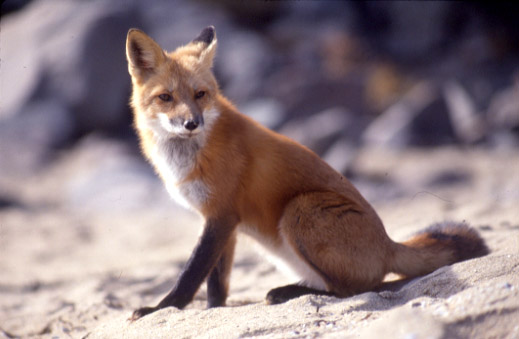
Flora and Fauna Friday - Red Fox

Flora and Fauna Friday - Red Fox

Red Fox (Vulpes Vulpes) is a small canid (a biological family of carnivorous and omnivorous mammals that includes wolves, foxes, jackals, coyotes and the domestic dog) native to much of North America including the Missouri Ozarks.


I saw one in the pasture south of our cabin on Monday of this week. Beautiful, actually; with a great long tail, looked very healthy. We stood and stared at each other, as I was on my walk. After a few moments, he bounded back into the woods nearby.

Source: http://en.wikipedia.org/wiki/Red_Fox

Friday, June 18, 2010

Flora and Fauna Friday - Shortleaf Pine

Flora and Fauna Friday - Shortleaf Pine

Shortleaf Pine (Pinus echinata) is a species of pine native to the eastern United States. Southern Missouri is on the very edge of the nativity of this pine. This tree is variable in form, sometimes straight, sometimes crooked, with an irregular crown. It my reach 20-30 m high witha diameter of 0.5-0.9 m.


Photo credit: Wikipedia Commons


This pine is a source of wood pulp, plywood veneer, and lumber for a variety of uses. This pine occupies a variety of habitats from rocky uplands to wet flood plains.

Source: http://en.wikipedia.org/wiki/Shortleaf_pine

"May each of us have a Homeplace to hold onto, if only in our minds."

Bill ;-)

Friday, June 11, 2010

Flora and Fauna Friday - Bluebirds

 
Flora and Fauna Friday - Bluebirds

The bluebird is the state bird of Missouri.

The bluebirds are a group of medium-sized, mostly insectivorous or omnivorous birds in the genus Sialia of the thrush family (Turdidae). Bluebirds are one of the few thrush genera in the Americas They have blue, or blue and red, plumage. Female birds are less brightly colored than males, although color patterns are similar and there is no noticeable difference in size between sexes.


Bluebirds are territorial, prefer open grassland with scattered trees and are cavity nesters. Bluebirds can typically produce between two and four broods during the spring and summer. Males identify potential nest sites and try to attract prospective female mates to those nesting sites with special behaviors that include singing and flapping wings, and then placing some material in a nesting box or cavity. If the female accepts the male and the nesting site, she alone builds the nest and incubates the eggs. Predators of young bluebirds in the nests can include snakes, cats and raccoons.

Source: http://en.wikipedia.org/wiki/Bluebird


"May each of us have a Homeplace to hold onto, if only in our minds."

Bill ;-)

Friday, June 4, 2010

Flora and Fauna Friday - The Showy Lady's Slipper

Flora and Fauna Friday


The Showy lady's Slipper, while it is the state flower of Minnesota and New Hampshire, can still be found in southern Missouri, though it is considered imiperiled. It thrives in neutral to basic soils and prefers growing in fens. Historically, it is difficult to raise. They typically flower in late June and early July. Usually there are one or two flowers per stem, but there can be three or four. The stem has a hairy appearance, and the "hairs" can cause irritation to some people.
Source: http://en.wikipedia.org/wiki/Cypripedium_reginae

"May each of us have a Homeplace to hold onto, if only in our minds."

Bill ;-)